
There are many books and journals available to guide you – or confuse you – but if you get seriously in the hobby it would be good to buy a few.
BOOKS
There are lots of books available on cacti and succulents for beginners. I don’t have any of those but if you are looking for one I recommend Cacti and Succulents: An Illustrated Guide to the Plants and Their Cultivation by Graham Charles who is, incidentally, the author of the BCSS’s cultivation pamphlet first published in 2019.
Beware of buying old books because the photographic quality is usually poor and the names are likely to have changed. When I started growing in the 1970s, Edgar and Brian Lamb used to churn out books regularly but the books look antiquated and are interesting more from a nostalgia point of view.
As for buying, Keith’s Plant Books is the go-to website for new and second-hand botanical books as he often has ones that are hard to find and which may appear on Abe Books at silly prices. Keith can be seen at various cactus marts and events in the UK and you can subscribe to his newsletter.
Another source of second-hand books is Mike Park who sometimes has ones on cacti and succulents.
The BCSS website sells its own publications but not all are terribly good and the selection is looking pretty dated so it’s best to check them out before ordering. Keith also sells BCSS books at the same price and may have them on display at the events he attends.
The late expert and author John Pilbeam self-published a number of books which are still offered for sale The same goes for Graham Charles whose book on the genus Gymnocalycium is a must-have if you are interested in these cacti (he had another book on matucanas in development).
There is also an online list of downloadable books HERE but all are very old and of little use to the novice.
The tables below includes some of the books I have in my library, not all of which are still in print unfortunately.
Cacti
When it comes to books for serious growers, there are far fewer on cacti than there are on succulents. There are a couple of large tomes which review all genera, and others that include more or less the lot in some kind of logical arrangement. Besides those, there are several more specialist books on specific genera or groups that are worth considering if you develop an interest in these. I don’t recommend buying books based on specific habitats unless you are planning to go there.
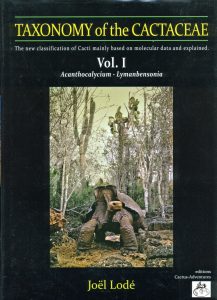 | Taxonomy of the Cactaceae by Joël Lodé comes in two stonking great volumes, ideal for pressing wild flowers. This is regarded by many as a usurper to David Hunt’s definitive work on cacti (below) as it’s based on DNA evidence to a large extent. The first half of each volume goes through every genus in turn, explaining the origins of the name and the botanical features, and listing the species. The second half is a collection of photographs of a great many of species. It’s a mammoth work which the author has self-published so one can forgive the rather idiosyncratic graphic design. Go to the cactus-adventures.com website to check availability. |
 | The New Cactus Lexicon was compiled and edited by members of the International Cactaceae Systematics Group led by the late David Hunt and first published in 2006 in two volumes under his imprimatur. Despite continued disagreement over the taxonomy of cacti, it is regarded by many as the definitive work. It is now out of print and since the death of Dr Hunt in 2019 it’s not clear when it might be republished. The Illustrations volume shown here was published in 2013 and you may still find it for sale. It has lots of photographs so is a good reference work. |
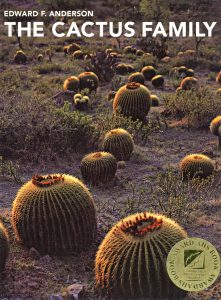 | The Cactus Family by Edward F. Anderson was published in 2001 and follows the classiciation of the International Cactaceae Systematics Group of which Dr Anderson was a member. The book is pretty comprehensive and if you are looking for something a bit smaller (although it’s pretty large at over 750 pages) then this may be for you. Well designed with good photographs, it’s probably more accessible than the first book on this list. I’m not sure if it’s still in print but you may be able to find a new or second-hand copy if you hunt around. |
 | Gymnocalycium in Habitat and Culture by Graham Charles covers this popular genus in detail. An expert on several cactus genera, the author’s professional background in publishing shows in this well-produced book. It’s not bedtime reading and definitely a reference book, but if you decide to grow these cacti in a serious way you will want to get hold of a copy. A book on Matucana is due out soon from the same author. Copies can be bought from the author. |
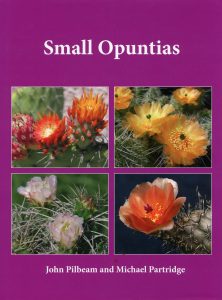 | Small Opuntias by John Pilbeam & Michael Partridge is an excellent review of the more manageable members of the Opuntioideae. Again, it is self-published and although the photographic reproduction is not the best in places, and the book is not comprehensive, it’s a good starting point if you are interested in these plants. The book goes through 13 genera one by one and ends with a few pages of wildlife photographs. Copies are available from the author. |
There are also some online resources for e-books, including those by Fritz Hochstätter published on Issuu.
Succulents
There are umpteen books on succulents for home decor but if you’re going to get serious give these a wide birth or just browse them in the bookshop if you are curious.
There has been a minor surge in books on Southern African succulents in recent years and since the majority of succulents come from this region it’s well worth investing in one or two.
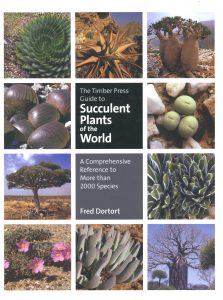 | Succulents Plants of the World by Fred Dotort was published in 2011 and is probably the best guide to succulents in general, not just the African ones. The book is structured in chapters which represent the main groupings, not by plant family, and is more accessible to the non-botanist for this reason. It includes some bromeliads and bulbs too, as well as some outlier succulent genera such as Begonia, Tradescantia and Sinningia. While some may disagree with the groupings, it is a very useful starting point if you are getting into succulents in a big way. |
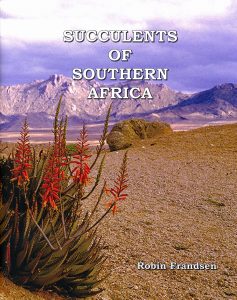 | Succulents of Southern Africa by Robin Frandsen is one of the more recent publications (2017) and is structured by plant family, beginning with the Asphodelaceae and ending with the virtually-impossible-to-grow Welwitschiaceae (of which there is only one species). Along the way, the author covers the main groups, albeit using a number of the old family names but that doesn’t matter. It is well laid out, despite the nightmare it must be to copy fit around all the excellent photographs of differing shapes and sizes. Since the vast majority of greenhouse succulents come from Southern Africa, you will find most of what you need here. |
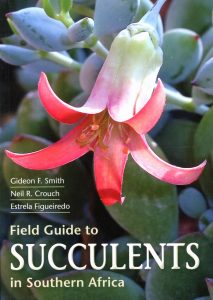 | Field Guide to Succulents in Southern Africa by Gideon F. Smith, et al (2017), might seem an odd one to include here and if you’re not heading off the South Africa soon to explore the flora I can quite see why. However, the paperback book is a handy size and more manageable guide to the main succulents families (using the most recent names) and key species, and includes families and genera I have never thought of as succulents. It even includes cacti which are introduced plants of course. Some of the photographs are quite small but the book is pretty accessible for the novice. |
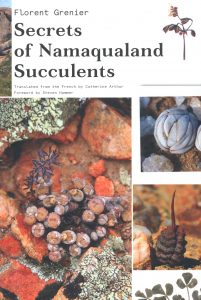 | Secrets of Namaqualand Succulents by Floreny Grenier is a 2019 translation of the French edition. Apart from the rather quirky typography (including some of the author’s own handwriting - fortunately rather neater than mine), the whole approach of the book is somewhat different to all the others. It looks at diversity, the various species (by family), habitats (including geological aspects), survival against all that man and nature throws at them, and reproduction. It’s a mix of traditional botany, systematics, ecology, geography, geology and open-toes sandal evangelism. If there’s any book you might want to sit up in bed and read it’s this one. |
 | Aloes: The Definitive Guide is a Kew publication with four authors (S. Carter, et al) published in 2011. It quickly went out of print and has not been reprinted, which is a shame. There are so many species of Aloe that the genus is rather bewildering but the book groups them by form, such as grass aloes, stemless aloes and tree aloes. The book is beautifully designed, as you would expect from Kew, and is the seminal work on this popular genus. You may already know that the genus Aloe has been split up thanks to DNA evidence, with a number of new genera created. |
 | Succulent and Xerophytic Plants of Madagascar by Werner Rauh, published in 1995 (Vol 1) and 1998 (Vol 2), are two spectacular tomes on the amazing and unique flora of this island. Collectors tend not to grow Madagascan succulents specifically so these books (if you can still find them) are really reference works and fascinating to leaf through. |
JOURNALS
There are a number of online and downloadable publications that are free and don’t require a subscription. With some you can sign up for notifications for when the next issue is ready to download. Taking advantage of this service really is a no-brainer as they can be very useful, not just for the interesting articles but also for the advertisements. The first two are ones I subscribe to but others are listed for interest (and partly plagiarised from the first one!).
The Cactus Explorers Club is produced by Graham Charles (see above), the former editor of the BCSS’s annual Bradleya journal, and is top notch. It appears three times a year (there is an alert service), slightly erratically but it’s worth waiting for.
The Cactus & Succulent Review (formerly the Essex Succulent Review) is published quarterly and has a variety of interesting and high-quality articles. There is an alert service which will send you an email with a link to the new editions as they are published.
Sansevieria Online is written in German with English summaries, but you can get the gist of the articles from the photographs.
Echinocereus Online is almost all in German and is probably too technical for anyone except the die-hard enthusiast.
Succulentopi@ (yes, it really has an ‘at’ symbol!) is completely in French so rustle up your schoolboy/girl skills and look at the lovely pictures. Publications appeared to stop in 2017 but in 2020 there was a further issue produced.
What makes a succulent a cactus?
. . . . Cacti
. . . . Other succulents
Taxonomy: A rose by any other name . . .
ID websites
Starting a collection
Where to buy plants
Societies and interest groups
Publications