
Watering your plants only in the growing season: from around late March to September. But read on . . .
This sounds sensible enough doesn’t it? Well, for cacti (except Christmas cacti) it is, as it is for the majority of other succulents, but you do need to know what you are watering and you may have to adjust the regime to fit.
CACTI
You can start watering in late March/early April but do so sparingly to begin with and only when you know that it’s going to be sunny. You need to give the roots time to grow and if you give too much water too soon the plant may rot. Too much water too quickly at the start of the growing season can cause some cacti to split (as can over-watering a number of the slow-growing species, such as Lophophora williamsii, at any time in the growing season).
Many cacti start to form flowers in February in the UK and may be in flower by March. This does not mean that they need watering – a lot of cacti flower in the wild before the rains fall – so the flowers won’t abort if you don’t water them. However, it’s a sign that spring is on the way and a little water on sunny days does no harm. This particularly applies to Mammillaria , Thelocactus and Turbinicarpus species, but I would be wary of watering too soon.

You can increase the watering as the weather warms up and as you see signs of growth (if you don’t see growth don’t just give more water – check out the When things go wrong section). The general rule for all cacti (except epiphytic species) is to let them dry out between waterings, as happens in the wild. If you use trays or saucers under the pots, ensure that any water that has flowed out the bottom has soaked up within a couple of hours. If it hasn’t, tip the excess water away.
As for stopping watering, if you don’t heat your greenhouse in the winter, or if you keep it just above freezing, you should stop watering in early September to give them time to dry out. If you have any late-flowering species (eg, Ariocarpus, but they are cacti for more experienced growers), you can give small amounts of water in October but then you should stop even if, as sometimes happens, a flower bud or two starts to form. If, like me, you keep your greenhouse above 5C at all times, you can continue watering at a reduced rate until late September but only during sunny periods when the greenhouse warms up significantly.
Epiphytic cacti, such as Schlumbergera and Zygocactus (Christmas/Easter cacti) need a little water all year round and a bit more when they start to come into flower. Some of mine are in the house because they don’t like to be moved once the flower buds start for form. If you buy a Christmas cactus from a garden centre before Christmas you may find that all the buds drop off so they don’t make the ideal gift. Keep them going and they will flower the following year, albeit a little earlier than Christmas.
SUCCULENTS
These are an odd bunch and this is where a bit of knowledge and experience helps. The rule about not letting them sit in water is the same as for cacti. Start watering cautiously the same time as cacti and keep an eye out for signs of growth. This is particularly important for caudiciforms (see the gallery section on those – eek!). You can increase the watering as the growing season progresses. Unlike cacti, most succulents can withstand a bit of over-watering so don’t worry too much.
A small number of succulents are true winter growers here in the UK because they come from southern Africa (although not all plants from that region are UK winter growers), which includes caudiciform pelargoniums, othonnas and tylecodons.
Several genera – particularly in the Crassulaceae – are spring/autumn growers and will throw up flower stalks during these periods and remain dormant during the height of the summer although they are not especially picky.
This also applies to haworthias (Asphodelaceae), but the related aloes, while UK summer growers, are said to benefit from a bit of water throughout the winter as it prevents their leaves from dying back too much. Gasterias can look similarly pitiful if deprived of water for months during the winter and I tend to give them a splosh every now and again. Shrivelling succulents will come back to life in the spring but it’s something to consider. Adromischus tend to drop their leaves in the winter if you so much as look at them.
Lithops and Conophytum species have strict watering regimes (not the same one), adherence to which is vital if you are to keep their shape and form and flowering pattern. This is less critical with most other ‘mesembs’ but you should read up about them. More information on this group can be found on the BCSS cultivation guide on mesembs or the Society’s more recent cultivation booklet. I picked up handy sheet giving a more complete list of genera and their growing/flowering months. I believe that the Mesemb Study Group produced this but it does not say.
The problem with winter/spring/autumn growers is that they may come back to life if you give them water any time of the year. I kept an unlabelled plant going this way and apart from a month or two of dormancy it kept growing. When it flowered after several years I realised that it was a winter-growing Othonna.
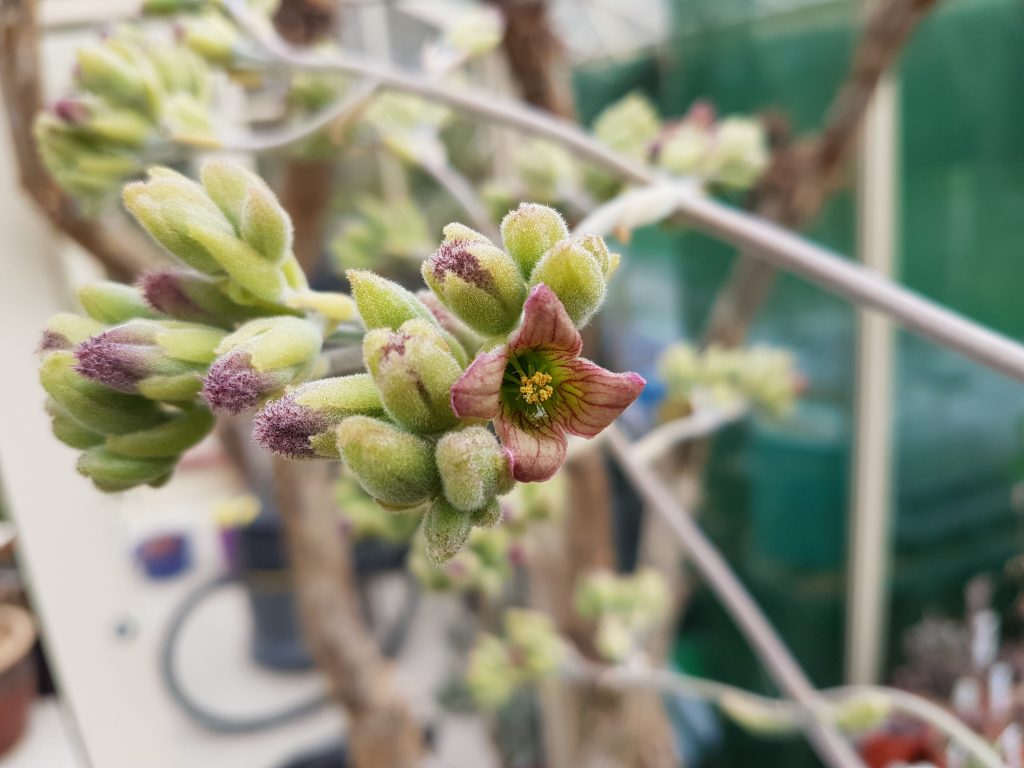
Don’t be surprised to see the odd flower stalk sprouts up at random times of the year, particularly among haworthias. Crassulas will flower in winter, as will some echeverias. If you don’t water them, flower formation gets delayed and you can wait for the spring.
To drench or to saucer, that is the question
I’m a saucer man myself and have bought hundreds of the things over the past 12 years. For a windowsill collection individual saucers are a must of course. Some people prefer to put their plants on trays (including those grown in greenhouses) but any water that comes out the bottom will water the surrounding plants so unless they all have the same watering regime it is best not to do this.
Many greenhouse growers put their plants on slatted benches and drench them at each watering so it runs out the bottom (all over whatever is underneath the bench). This has always seemed wasteful to me and if, as I do, you use a weak fertiliser for most waterings, it’s doubly wasteful. Only you can decide what to do but I encourage you to experiment to see what you prefer.
Use a watering can with a downward-pointing spout, such as those made by Haws (although the spouts nearly always split), and water the compost or top dressing rather than the plant itself. At the height of the summer when watering becomes more frequent, I often use a hosepipe but still water in the same way. Some growers admit to spraying the whole lot with a hosepipe fitted with a rose but if you live in a hard water area this can leave a chalky residue.
Watering plants in the evening on a sunny day is best, so long as you know that it’s also going to be sunny the next day. Early morning, before the temperature rises is the next best time. You need to give the plants a chance to absorb the water before it starts to evaporate or your efforts will have been largely wasted.
Windowsill, Conservatory or Greenhouse?
Growing outdoors
Watering
Compost
Pots & containers
Top dressing
Potting up
Fertilizer
When things go wrong